Dr. Saint Paul

Dr. Saint Paul

Dr. Saint Paul is a pharmacy educator, Pharm.D graduate, and academic content creator from Jawaharlal Nehru Technological University Kakinada (JNTUK), where he completed his Doctor of Pharmacy (Pharm.D) degree between 2015 and 2021. He has more than 7 years of experience creating pharmacy educational content, writing study materials, and reviewing academic articles for pharmacy students. He has also contributed guest articles to pharmacy education platforms, including PharmD Guru. At D.PharmGuru, his work focuses on simplifying complex Diploma in Pharmacy (D.Pharmacy) subjects into easy-to-understand notes, practical explanations, and exam-oriented educational resources for students across India. His areas of focus include Human Anatomy and Physiology, Pharmaceutics, Pharmacology, Pharmaceutical Chemistry, Hospital and Clinical Pharmacy, and other core D.Pharmacy subjects.

16. SENSE ORGANS

16. SENSE ORGANS

SENSE ORGANS Sense organs have specialised nerve cells which receive stimuli and convert them into appropriate nerve impulses. These nerve impulses are carried to the CNS by afferent or sensory nerve fibres. The sense organs – eyes, ears, tongue, skin,…

15. NERVOUS SYSTEM

15. NERVOUS SYSTEM

NERVOUS SYSTEM The nervous system is a highly advanced network of specialised cells called neurons that help in coordinating body functions and transmitting signals between different body parts. A single nerve is a collection of various neurons. Layers of Connective…

14. SKELETAL MUSCLES

14. SKELETAL MUSCLES

SKELETAL MUSCLES The contractile tissue derived from the mesodermal (middle) layer of germ cells during embryonic development is known as a muscle. Muscles are basically of three types: 1) Skeletal muscles (voluntary), 2) Smooth muscles (involuntary), and 3) Cardiac muscles…

13. DIGESTIVE SYSTEM

13. DIGESTIVE SYSTEM

DIGESTIVE SYSTEM The digestive system transfers nutrients from the external environment (in the form of food) to the internal environment (via ingestion of food). In the internal environment, nutrients are distributed to different cells of the body via the circulatory…

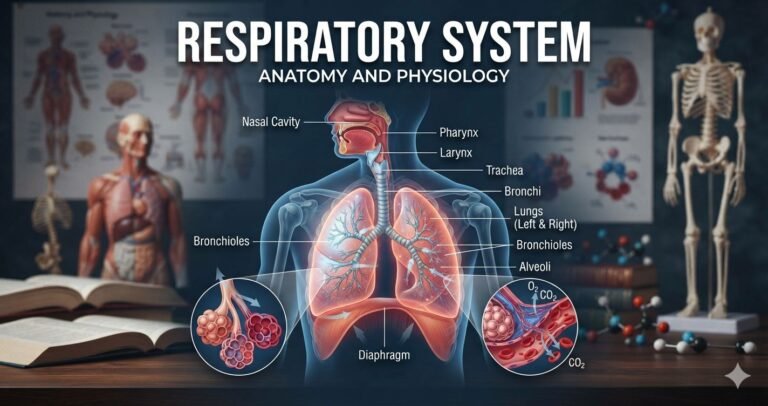
12. RESPIRATORY SYSTEM

12. RESPIRATORY SYSTEM

RESPIRATORY SYSTEM The respiratory tract forms the path through which air passes from the nose to the lungs. Exchange of gases during internal and external respiration is the major function of the respiratory system, along with filtering, warming, and humidifying…

10. LYMPHATIC SYSTEM

10. LYMPHATIC SYSTEM

INTRODUCTION TO LYMPHATIC SYSTEM The lymphatic system forms a closed network of lymph vessels through which lymph circulates all over the body. The flow of lymphatic fluid is unidirectional, from tissue spaces to the blood. The lymphatic system protects the…

9. IMPORTANCE OF BLOOD GROUPS

9. IMPORTANCE OF BLOOD GROUPS

BLOOD GROUP BLOOD GROUP: A blood type or blood group is the classification of blood on the basis of the presence or absence of inherited antigens (proteins, carbohydrates, glycoproteins, or glycolipids) on the surface of RBCs. Significance of Blood Grouping…

8. MECHANISM OF BLOOD CLOTTING

8. MECHANISM OF BLOOD CLOTTING

BLOOD CLOTTING (COAGULATION) Blood coagulation (or blood clotting) is the process by which blood from its liquid state changes to a gel-like consistency. A host defence mechanism known as haemostasis is a complex process which blocks the bleeding from a…

7. PROCESS OF HEMOPOIESIS

7. PROCESS OF HEMOPOIESIS

PROCESS OF HEMOPOIESIS HEMOPOIESIS: Around 250 billion (25 × 10¹⁰) new RBCs, 20 billion (20 × 10⁹) new WBCs, and 25 billion (20 × 10⁹) platelets are required for replacing aged or dead cells each day. Formation of blood cells…