Tissues of the Human Body
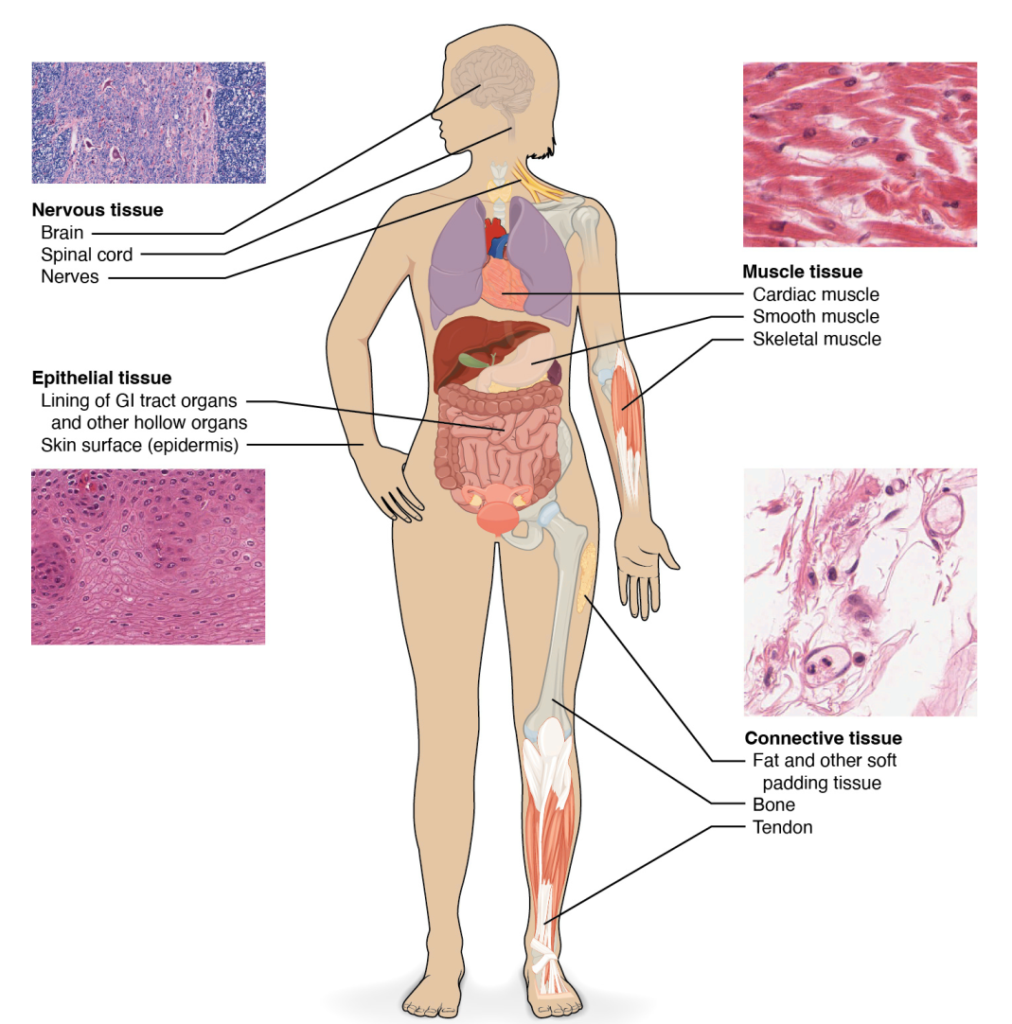
In the human body, tissues are groups of similar cells that work together to perform a specific function. When cells of the same type combine, they form tissues, and when different tissues combine, they form organs such as the heart, lungs, kidneys, and liver.
The scientific study of tissues is known as Histology. Based on structure and function, the human body is composed of four basic types of tissues.
- Epithelial tissue
- Connective tissue
- Muscular tissue
- Nervous tissue
1. Epithelial Tissue:
Epithelial tissue covers the external surface of the body, lines internal organs and cavities, and forms various glands. It acts as a protective barrier and plays an important role in absorption, secretion, and sensation.
Characteristics of Epithelial Tissue:
- Cells are tightly packed with very little intercellular space.
- Has a free surface and a basement membrane.
- Lacks blood supply; nutrients diffuse from underlying tissues.
- Has a high regenerative capacity.
Types of Epithelial Tissue:
A. Simple Epithelium (Single Layer of Cells):
- Simple Squamous Epithelium: Thin, flat cells.
Location: Alveoli of lungs, blood vessels.
Function: Diffusion and filtration. - Simple Cuboidal Epithelium: Cube-shaped cells.
Location: Kidney tubules, glands.
Function: Secretion and absorption. - Simple Columnar Epithelium: Tall, column-like cells.
Location: Stomach, intestine.
Function: Absorption and secretion. - Ciliated Epithelium: Cells with hair-like cilia.
Location: Respiratory tract, fallopian tubes.
Function: Movement of mucus or ovum.
B. Stratified Epithelium (Multiple Layers of Cells):
- Stratified Squamous Epithelium: Many layers of flat cells.
Location: Skin, mouth, esophagus.
Function: Protection against wear and tear. - Transitional Epithelium: Stretchable epithelium.
Location: Urinary bladder.
Function: Allows expansion and contraction.
2. Connective Tissue:
Connective tissue is the most abundant tissue in the human body. It connects, supports, binds, and protects different organs and structures.
Main Components of Connective Tissue:
- Cells: Fibroblasts, macrophages, mast cells.
- Fibers: Collagen, elastic, and reticular fibers.
- Ground Substance: Gel-like matrix surrounding cells.
Types of Connective Tissue:
A. Connective Tissue Proper:
- Loose Connective Tissue:
- Areolar Tissue: Fills spaces between organs.
- Adipose Tissue: Stores fat and provides insulation.
- Dense Connective Tissue:
- Tendons: Connect muscles to bones.
- Ligaments: Connect bones to bones.
B. Specialized Connective Tissue:
- Cartilage: Smooth and flexible tissue.
Location: Nose, ear, joints.
Function: Support and flexibility. - Bone: Hard, rigid tissue rich in calcium.
Function: Provides support, protection, and shape. - Blood: Fluid connective tissue.
Function: Transport of gases, nutrients, hormones, and wastes.
3. Muscular Tissue:
Muscular tissue is responsible for movement of the body and internal organs. It contains contractile proteins that enable contraction and relaxation.
Types of Muscular Tissue:
- Skeletal Muscle:
- Voluntary control.
- Striated appearance.
- Location: Arms, legs, face.
- Smooth Muscle:
- Involuntary control.
- Non-striated, spindle-shaped cells.
- Location: Walls of stomach, intestines, blood vessels.
- Cardiac Muscle:
- Found only in the heart.
- Striated, branched, and involuntary.
- Function: Continuous pumping of blood.
4. Nervous Tissue:
Nervous tissue forms the brain, spinal cord, and nerves. It is responsible for receiving stimuli, transmitting nerve impulses, and coordinating body activities.
Main Components of Nervous Tissue:
- Neuron: Structural and functional unit of nervous tissue.
- Neuroglia (Glial Cells): Support, protect, and nourish neurons.
Functions of Nervous Tissue:
- Receives sensory stimuli.
- Transmits electrical impulses.
- Coordinates and controls body functions.
Summary:
Tissues are fundamental components of the human body that enable structure, movement, protection, and communication. A clear understanding of the types of tissues and their functions is essential for pharmacy students, as it forms the basis for studying anatomy, physiology, pathology, and pharmacology.
Frequently Asked Questions (FAQs)
1. What is a tissue?
A tissue is a group of similar cells that work together to perform a specific function.
2. How many types of tissues are present in the human body?
There are four main types of tissues: epithelial, connective, muscular, and nervous.
3. Which tissue covers the body surfaces?
Epithelial tissue covers body surfaces and lines internal organs.
4. Which tissue is responsible for movement?
Muscular tissue is responsible for body movements and movements of internal organs.
5. What is the function of nervous tissue?
Nervous tissue receives, transmits, and processes nerve impulses to coordinate body activities.