Clearance Tests and Micturition
Introduction
The kidneys play a vital role in maintaining the internal environment of the body by filtering blood, excreting waste, and regulating water and electrolyte balance.
To evaluate how efficiently the kidneys are functioning, renal clearance tests are performed.
In addition, the process of micturition explains how urine is stored and expelled from the body.
Clearance Tests
Definition
A clearance test is a measure of the volume of plasma completely cleared of a particular substance by the kidneys per minute.
It helps assess the glomerular filtration rate (GFR), tubular reabsorption, and tubular secretion.
Formula:
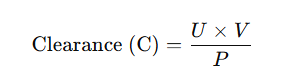
Where:
- U = concentration of the substance in urine
- V = volume of urine excreted per minute
- P = concentration of the substance in plasma
Types of Clearance Tests
1. Inulin Clearance Test
- Purpose: To measure glomerular filtration rate (GFR) accurately.
- Reason: Inulin is freely filtered at the glomerulus and neither reabsorbed nor secreted by the tubules.
- Normal Value: About 125 mL/min in a healthy adult.
2. Creatinine Clearance Test
- Purpose: To estimate GFR using a naturally produced substance.
- Reason: Creatinine is produced by muscles and freely filtered; only a small amount is secreted by tubules.
- Normal Value: 90–140 mL/min in adults.
- Clinical Use: Commonly used to assess kidney function in routine practice.
3. Urea Clearance Test
- Purpose: To measure overall renal function.
- Reason: Urea is filtered and partially reabsorbed; hence, less accurate than inulin or creatinine clearance.
- Normal Value: 40–70 mL/min.
4. PAH (Para-Aminohippuric Acid) Clearance Test
- Purpose: To measure renal plasma flow (RPF).
- Reason: PAH is completely removed from plasma by filtration and secretion.
- Normal Value: 600–700 mL/min.
Clinical Significance of Clearance Tests
- Decreased Clearance: Indicates renal failure, glomerulonephritis, or renal obstruction.
- Increased Clearance: May occur in hyperfiltration states (early diabetes).
- Routine Tests: Serum creatinine and creatinine clearance are common for evaluating kidney efficiency.
Micturition
Definition
Micturition is the process of expelling urine from the urinary bladder through the urethra. It is a reflex activity under both voluntary and involuntary control.
Anatomy Involved in Micturition
- Urinary Bladder: A muscular sac that stores urine (capacity: 400–600 mL).
- Detrusor Muscle: Smooth muscle layer of the bladder wall responsible for contraction during urination.
- Internal Urethral Sphincter: Involuntary muscle at the bladder neck.
- External Urethral Sphincter: Voluntary skeletal muscle that controls urination consciously.
Mechanism of Micturition
- Filling Phase:
- Urine from the kidneys enters the bladder via ureters.
- As the bladder fills, stretch receptors in the bladder wall are activated.
- Micturition Reflex:
- Stretch receptors send signals to the sacral spinal cord (S2–S4).
- Parasympathetic nerves stimulate the detrusor muscle to contract.
- The internal sphincter relaxes involuntarily.
- Voluntary Control:
- The external sphincter, controlled by the cerebral cortex, relaxes when urination is desired.
- Urine is expelled through the urethra.
- After Emptying:
- The detrusor muscle relaxes.
- The bladder starts filling again, restarting the cycle.
Disorders of Micturition
| Disorder | Description |
|---|---|
| Urinary Retention | Inability to empty the bladder completely. |
| Incontinence | Involuntary leakage of urine. |
| Overactive Bladder | Frequent and urgent need to urinate due to involuntary bladder contractions. |
| Neurogenic Bladder | Loss of bladder control due to spinal cord or nerve injury. |
Functions of Micturition
- Removes waste products and toxins.
- Regulates water and electrolyte balance.
- Maintains acid–base balance.
- Prevents infection by flushing bacteria from the urinary tract.