Introduction to Pharmaceutical Chemistry
Pharmaceutical Chemistry is the branch of science that studies how medicines are discovered, prepared, analyzed, and used to treat diseases. It connects chemistry, biology, and pharmacy to understand how chemical compounds are converted into safe and effective drugs.
In simple terms, pharmaceutical chemistry explains how chemicals become medicines, how drugs act inside the body, and how their purity, safety, and quality are ensured before use.
Pharmaceutical chemistry mainly deals with:
- Discovery and design of drugs
- Understanding drug action, absorption, and metabolism
- Testing safety, purity, and quality of medicines
- Study of drug impurities and side effects
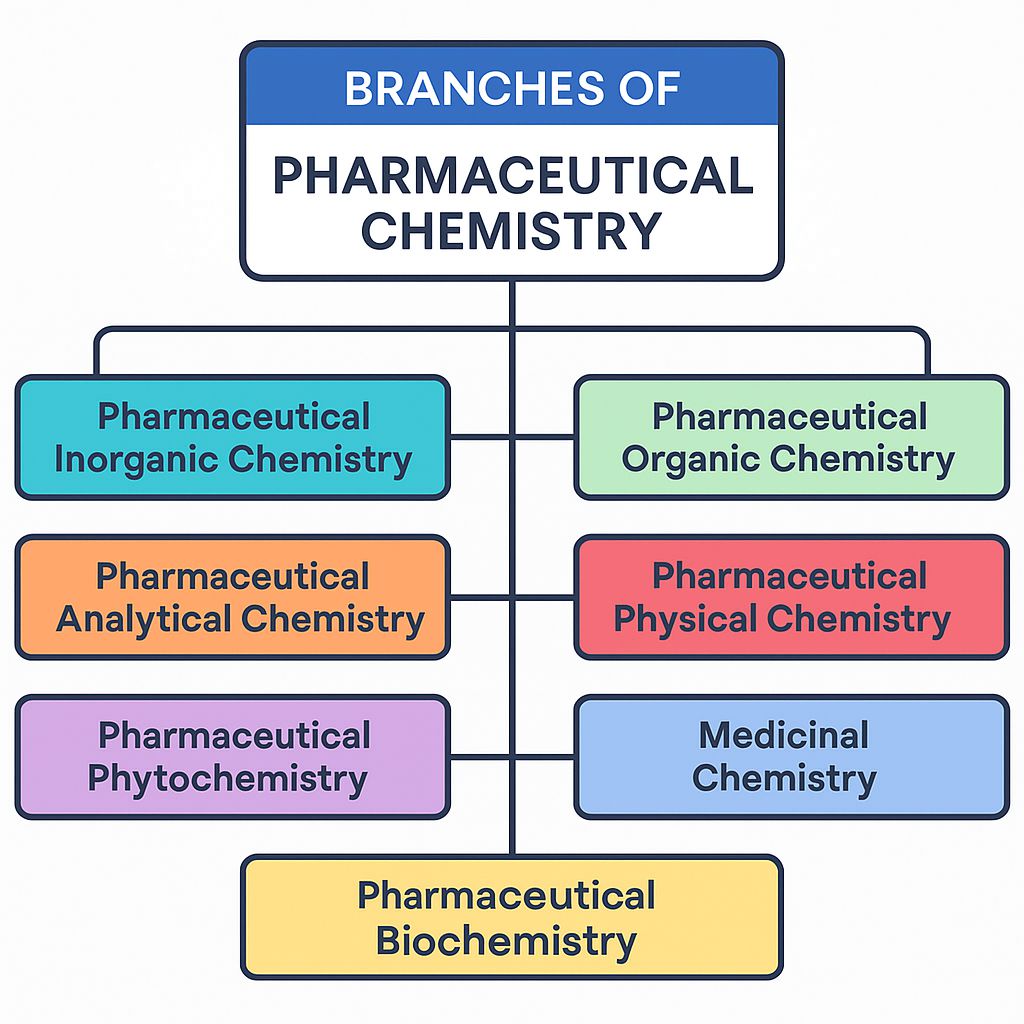
Branches of Pharmaceutical Chemistry:
Pharmaceutical chemistry is divided into several important branches, each focusing on a specific aspect of drug science.
1. Pharmaceutical Inorganic Chemistry:
This branch deals with inorganic drug substances, their preparation, identification, purity tests, storage conditions, and therapeutic uses. It includes compounds such as electrolytes, antacids, and diagnostic agents.
2. Pharmaceutical Organic Chemistry:
Pharmaceutical organic chemistry focuses on carbon-containing compounds used as drugs. It studies their structure, chemical reactions, synthesis, and stability.
3. Pharmaceutical Analytical Chemistry:
This branch deals with qualitative and quantitative analysis of drugs. It ensures that medicines meet standards of identity, purity, and strength using chemical and instrumental methods.
4. Pharmaceutical Physical Chemistry:
Pharmaceutical physical chemistry applies principles such as solubility, pH, diffusion, partition coefficient, and thermodynamics to understand drug behavior and formulation.
5. Pharmaceutical Phytochemistry:
Phytochemistry studies chemical constituents obtained from plants. These natural compounds are used as medicines or as raw materials for drug development.
6. Medicinal Chemistry:
Medicinal chemistry involves the design, synthesis, and development of new drugs. It studies the relationship between chemical structure and biological activity.
7. Pharmaceutical Biochemistry:
This branch examines how drugs interact with biomolecules such as enzymes, proteins, DNA, and receptors inside the body.
Scope of Pharmaceutical Chemistry:
Pharmaceutical chemistry offers wide career opportunities in academic, industrial, and research fields. Professionals can work in:
- Drug discovery and development
- Pharmaceutical manufacturing units
- Quality control and quality assurance laboratories
- Research and development centers
- Teaching institutions and training centers
- Regulatory agencies and analytical laboratories
Pharmaceutical chemists often work in collaboration with pharmacologists, microbiologists, toxicologists, and biotechnologists to develop safe and effective medicines.
Objectives of Pharmaceutical Chemistry:
- Ensure drugs are safe, effective, and of standard quality
- Develop skills in chemical handling and laboratory techniques
- Train students for research and analytical work
- Understand quality assurance and quality control systems
- Prepare professionals for pharmaceutical and biomedical industries
- Promote laboratory safety and awareness of chemical hazards
Sources and Types of Errors and Impurities:
Errors and impurities are common challenges in pharmaceutical preparation and analysis. They may affect the quality, safety, and effectiveness of medicines.
Sources of Errors:
- Incorrect measurement of chemicals
- Faulty instruments or improper calibration
- Human errors during manufacturing or testing
- Improper laboratory procedures
Types of Impurities:
- Raw material impurities from contaminated sources
- Manufacturing impurities formed as reaction by-products
- Storage impurities due to light, heat, moisture, or air
Quality Control in Pharmaceutical Chemistry:
Quality control involves testing drugs for impurities and verifying that they meet pharmacopoeial standards. Strict quality assurance practices ensure that medicines reaching patients are safe, pure, and effective.
Quality control includes chemical tests, instrumental analysis, and stability studies to maintain consistency and reliability in pharmaceutical products.
Summary:
Pharmaceutical chemistry forms the backbone of drug development and quality assurance. It helps transform chemical substances into safe medicines and ensures their effectiveness through scientific testing and analysis. For pharmacy students, it provides essential knowledge required for pharmaceutical practice, research, and industry.
Frequently Asked Questions (FAQs)
1. What is pharmaceutical chemistry?
It is the branch of science that studies drug discovery, preparation, analysis, and quality control.
2. Why is pharmaceutical chemistry important in pharmacy?
It ensures medicines are safe, pure, effective, and manufactured according to standards.
3. Which branch deals with testing drug purity?
Pharmaceutical analytical chemistry deals with testing and analysis of drug purity and strength.
4. What is the role of medicinal chemistry?
Medicinal chemistry focuses on designing and developing new drug molecules.
5. What causes impurities in drugs?
Impurities may arise from raw materials, manufacturing processes, or improper storage conditions.