Hospital Pharmacy
Definition:
Hospital pharmacy is an integral department of a hospital where drugs are manufactured or procured, stored, dispensed, and their use is monitored. It also provides drug information, education, and training services to inpatients, outpatients, and healthcare professionals through a team of qualified pharmacists.
Origin and Development of Hospital Pharmacy:
In earlier days, a pharmacy functioning inside a hospital was known as hospital pharmacy, similar to a community pharmacy serving the public. Initially, hospital pharmacies were mainly involved in dispensing medicines to patients with prescriptions.
Modern hospital pharmacy has evolved far beyond simple dispensing. Its scope now covers the entire range of drug-related services, starting from manufacturing to therapeutic drug monitoring and clinical pharmacy services. Today, pharmacists are expected to collect medication histories, advise doctors on suitable drug selection, monitor drug therapy, intervene to correct treatment when required, and counsel patients during treatment and at discharge.
This transformation from a product-oriented service to a patient-oriented service has greatly expanded the objectives and functions of hospital pharmacy.
In India, such advanced hospital pharmacy services are available only in a few institutions, such as Christian Medical College, Vellore, and Trivandrum Medical College. However, these services are expected to expand in the future as healthcare awareness increases.
Organisational Structure of Hospital Pharmacy:
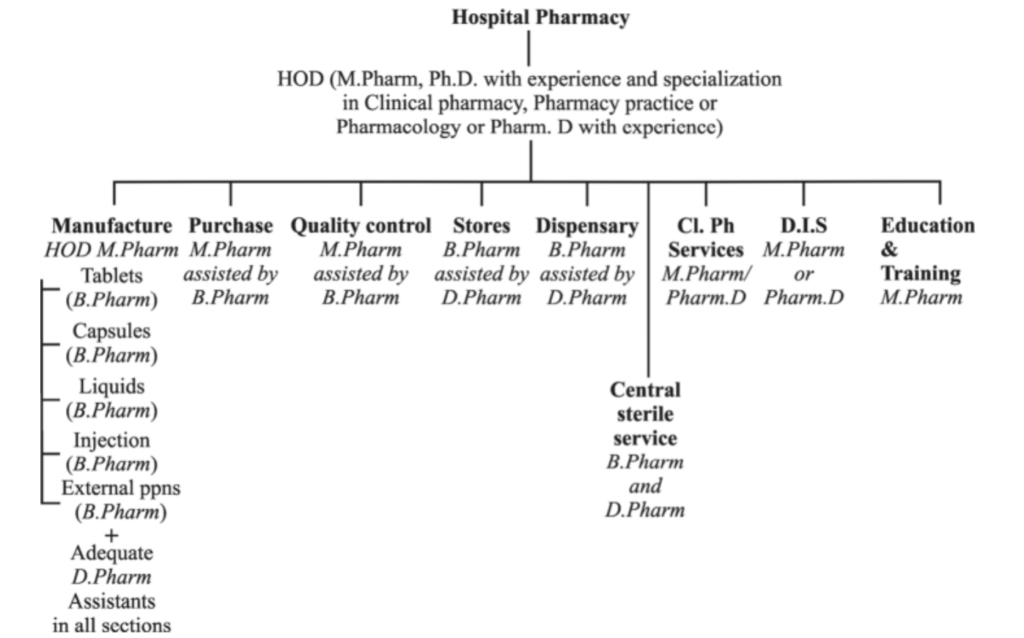
The organisational structure of a hospital pharmacy begins with a qualified and experienced Head of the Department. Ideally, this position is held by an M.Pharm with Ph.D or a Pharm.D graduate with extensive experience in hospital pharmacy services.
The Head of the Department is supported by section heads responsible for manufacturing, quality control, stores, dispensary, clinical pharmacy services, central sterile services, drug information services, and education and training.
D.Pharm holders are appointed as supporting staff in dispensing, manufacturing assistance, and sterile services. Clinical pharmacy services require highly qualified pharmacists such as M.Pharm or Pharm.D graduates.
Major Sections of a Modern Hospital Pharmacy
- Manufacturing Section
- Purchase Section
- Quality Control Section
- Stores Section
- Dispensary
- Central Sterile Supply Department
- Clinical Pharmacy Services
- Drug Information Centre
- Education and Training Section
Staffing and Workload Considerations:
The number of staff required in a hospital pharmacy depends on the workload and range of services provided. Each section requires trained and experienced personnel. Proper workload calculation helps reduce patient waiting time and improves service quality.
Inadequate staffing leads to excessive workload, long working hours, and reduced quality of pharmaceutical care. Hence, systematic planning of manpower is essential.
Infrastructure Requirements:
An effective hospital pharmacy requires strong infrastructure support, including manufacturing and analytical equipment as per Drugs and Cosmetics Act, proper storage facilities, sterile service units, uninterrupted power supply, and a well-equipped library.
Office facilities, clerical support, and modern data management systems are also necessary to maintain efficiency.
Functions of Hospital Pharmacy Sections:
Manufacturing Section:
This section estimates annual drug demand, plans production schedules, manufactures formulations, prepares special products like IV admixtures, and ensures quality through coordination with quality control.
Purchase Section:
Responsible for estimating drug requirements, preparing specifications, following purchase procedures, receiving drugs, and handling emergency purchases.
Quality Control Section:
Ensures the quality of manufactured and purchased drugs through analysis, reporting, research, and coordination with external laboratories when needed.
Stores Section:
Manages proper storage, inventory control, issue of drugs, monitoring usage patterns, and handling expiry-related issues.
Dispensary:
Handles dispensing of medicines to outpatients, repacking, labeling, maintaining records, and providing a clean and comfortable waiting environment.
Central Sterile Supply Department:
Manages sterilization of medical equipment, maintains inventory, supplies sterile items, and educates departments on infection control.
Clinical Pharmacy Services:
Clinical pharmacists conduct medication history interviews, assist in drug selection, monitor therapy, detect adverse drug reactions, counsel patients, and ensure continuity of care after discharge.
Drug Information Services:
Provides accurate and updated drug information to healthcare professionals and the public, prepares bulletins, and maintains drug literature resources.
Education and Training Services:
Conducts training programs for pharmacy, nursing, and medical students, educates hospital staff, and participates in public health education.
Materials and Financial Management in Hospital Pharmacy:
Materials management focuses on planning, purchasing, storing, and controlling materials to ensure uninterrupted service at minimal cost. It follows the principle of purchasing the right material, at the right time, in the right quantity, from the right source, at the right price.
Financial management involves planning and controlling departmental expenses, assisting hospital administration in budget preparation, minimizing wastage, and exploring cost-saving opportunities such as in-house drug manufacturing.
Role and Responsibilities of Hospital Pharmacist:
The role of the hospital pharmacist has expanded from dispensing medicines to manufacturing, quality control, clinical pharmacy services, education, drug information, and inventory management.
Chief Pharmacist:
The chief pharmacist is responsible for planning, organizing, supervising, and controlling all hospital pharmacy activities. He coordinates with hospital committees, ensures quality services, supervises staff training, and maintains interdepartmental collaboration.
Other Pharmacists:
Pharmacists working in different sections must be trained to handle multiple roles to ensure uninterrupted services during emergencies or staff shortages.
Supportive Services in Hospitals:
Supportive or paramedical services work alongside clinical departments to ensure effective patient care. These include pharmacy, nursing, dietary, laboratory, medical records, and social services.
Medical Tourism and Hospital Pharmacy:
Medical tourism is a growing sector in India due to affordable treatment costs and advanced healthcare facilities. The involvement of clinical pharmacists enhances drug safety and patient satisfaction, making Indian hospitals more attractive to international patients.
Summary:
Hospital pharmacy is a dynamic and patient-focused discipline that plays a crucial role in healthcare delivery. With proper organization, staffing, infrastructure, and management, hospital pharmacy can significantly improve patient safety, treatment outcomes, and overall healthcare quality.
Frequently Asked Questions (FAQs)
1. What is hospital pharmacy?
Hospital pharmacy is a department that manages drug procurement, manufacturing, dispensing, monitoring, and patient care services within a hospital.
2. How is modern hospital pharmacy different from traditional pharmacy?
Modern hospital pharmacy focuses on patient-oriented services such as clinical pharmacy and drug monitoring, unlike traditional pharmacy which mainly involved dispensing.
3. Who can head a hospital pharmacy department?
An experienced M.Pharm with Ph.D or a Pharm.D graduate with extensive hospital experience can head the department.
4. What is the role of clinical pharmacists in hospitals?
Clinical pharmacists monitor drug therapy, prevent medication errors, counsel patients, and assist doctors in treatment decisions.
5. Why is hospital pharmacy important in medical tourism?
Advanced hospital pharmacy services improve patient safety and treatment outcomes, increasing trust among international patients.