History of the Profession of Pharmacy in India
The profession of pharmacy in India has a long and well-defined history that reflects the country’s journey from traditional medicine systems to a modern, regulated healthcare profession. For D.Pharmacy and B.Pharmacy students, understanding this evolution is essential to appreciate the role pharmacists play in today’s healthcare system.
1. Early Origins and Traditional Systems:
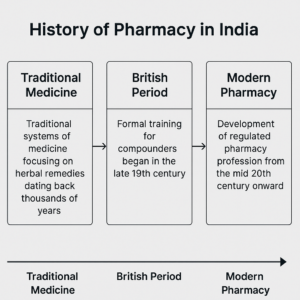
The roots of pharmacy in India can be traced back thousands of years and are closely associated with traditional systems of medicine such as Ayurveda, Unani, and Siddha. In ancient times, vaidyas and hakims prepared medicines using herbs, minerals, and animal products. These preparations were based on well-documented texts and empirical knowledge passed down through generations.
Although pharmacy practice existed in an unorganized form for centuries, formal training in pharmacy began during the British period. Historical records indicate that the training of compounders started around 1881 in Bengal, marking the beginning of structured pharmaceutical education in India.
2. Key Legislative Milestones:
The need for regulation became evident with the growth of drug manufacturing and importation. This led to the introduction of important legislations in the 20th century that transformed pharmacy into a regulated profession.
- Drugs and Cosmetics Act, 1940: Enacted to regulate the import, manufacture, distribution, and sale of drugs and cosmetics, ensuring their quality, safety, and efficacy.
- Pharmacy Act, 1948: A landmark legislation that formally recognized pharmacy as a profession and led to the establishment of the Pharmacy Council of India (PCI) to regulate pharmacy education and professional practice.
These laws laid the legal foundation for pharmacy practice in India and ensured that medicines reaching the public met acceptable standards.
3. Growth of Pharmacy Education and Professional Bodies:
Pharmacy education expanded significantly after independence. The first degree-level pharmacy course in India was introduced at Banaras Hindu University (BHU) in 1937, even before the Pharmacy Act was enacted.
To promote the interests of pharmacists and encourage professional development, the Indian Pharmaceutical Association (IPA) was established in 1939. The IPA has played a key role in advancing pharmaceutical science, education, and ethical pharmacy practice in India.
These developments strengthened the professional identity of pharmacists and encouraged research, innovation, and standardized education.

4. Modern Pharmacy Practice and Emerging Trends:
In the present healthcare system, the role of pharmacists extends far beyond dispensing medicines. Pharmacists are actively involved in patient counseling, hospital and clinical pharmacy, pharmaceutical manufacturing, quality control, quality assurance, regulatory affairs, and pharmacovigilance.
With advancements in biotechnology, digital health, and global pharmaceutical trade, the pharmacy profession continues to evolve. Indian pharmacists now contribute significantly to both national and international healthcare systems.
5. Importance of Studying the History of Pharmacy:
Studying the history of pharmacy helps students and professionals to:
- Understand the importance of drug regulation and quality control.
- Appreciate the professional growth and responsibilities of pharmacists.
- Recognize how education and legislation shaped modern pharmacy practice.
- Develop respect for the ethical and social role of pharmacists in healthcare.
Summary:
The profession of pharmacy in India has evolved from traditional medicine preparation to a scientifically advanced and legally regulated healthcare profession. Continuous improvements in education, research, and regulatory frameworks have positioned Indian pharmacists as key contributors to patient care and pharmaceutical innovation, both nationally and globally.
Frequently Asked Questions (FAQs)
1. When did pharmacy education start in India?
Formal pharmacy education in India began in the late 19th century, with the training of compounders starting around 1881. Degree-level pharmacy education started in 1937 at Banaras Hindu University.
2. Which act regulates the pharmacy profession in India?
The Pharmacy Act, 1948 regulates the pharmacy profession in India and established the Pharmacy Council of India (PCI).
3. What is the role of the Drugs and Cosmetics Act, 1940?
The Drugs and Cosmetics Act, 1940 ensures that drugs and cosmetics manufactured, imported, and sold in India meet standards of quality, safety, and efficacy.
4. Why is the history of pharmacy important for D.Pharmacy students?
It helps students understand the evolution of the profession, the importance of regulations, and the responsibilities of pharmacists in ensuring safe and effective healthcare.
5. What are the current career roles of pharmacists in India?
Pharmacists work in community and hospital pharmacies, pharmaceutical industries, quality assurance, regulatory affairs, clinical research, and patient counseling services.